| The Beauty Myth
The Signs of AgingBy Catherine RedfernWrinkles? Come and have a go, if you think you're hard enough. Go on then, crows-feet, you don't scare me! I laugh at you! Ha ha ha! Grey? Grey? It's silver, you imbecile. Yes, you too can have this attitude to aging. Just follow our three step plan. Did you also know that "what every woman wants for Christmas" (or Easter, or Mothers Day) is "younger looking skin"? Did you also know there are seven signs of aging? Oh yes. According to the cosmetic company Olay, it's not just 'aging' in general that women fear, but now there are seven separate 'signs' which they've helpfully and very generously identified for us. These are, in no particular order:
Olay's new range of skin care products, the Total Effects range, promises to actually reverse the aging process: 'or your money back!' Every part of our bodies are potential traitors that will reveal the dreaded secret of our age. Fear of aging is part of female culture in our society. Fair enough, part of it is due to plain fear and denial of what will eventually come to us all - death. This affects men too. However, when you really think about it, society gives women certain images and ideas about age that encourage us to try to halt the visible signs of the process. Many female beauty routines are an attempt to erase or prevent the signs of aging. Women are encouraged to dye their hair to get rid of grey; use age-defying creme every morning and night; if our faces get saggy there's always surgery; if our breasts droop we can get implants to keep them perky. And, as Olay point out, every part of our bodies are potential traitors that will reveal the dreaded secret of our age - even our hands: 'To tell a woman's age, they used to say, look at her hands. Not any more.' That is, only if you use Olay's hand cream. The other thing is, it's never too young to start this pointless process of holding back the years. Olay have regularly targeted young women as well as old, telling them if they start now, years before even a whisper of a wrinkle will appear on their peachy smooth skin, they'll benefit later. Another recent tv advert showed a young women who can't have been more than 22, running through fields, twirling round giggling, hands clasped to cheeks in a goofy smile (you know, the usual), while the voiceover intoned: "First wrinkles? I never even think about them." (yeah, right). "I just use [insert pretentious brand name here] every morning and evening." If that's what happens when she never thinks about it, I'd hate to see what beauty routine she follows when it is on her mind. If our fear of age was purely about getting closer to death, then surely that problem would best be dealt with by coming to terms with the inevitable, preparing our minds to cope with it, rather than simply trying to appear visibly younger - constantly chasing after a impossible goal in a constant state of denial. There has to be something else going on. Profit is a big part of it. But so is the idea of beauty we are presented. "Keep young and beautiful It's your duty to be beautiful. Keep young and beautiful, If you want to be loved" The problem is that beauty has always been associated with youth. Cosmetic companies just cannot comprehend the notion that beauty and youth are not inextricably connected. Its little wonder we don't want to get old when things like Olay's seven signs suggest this is all aging brings: dullness, uneven-ness, blotches. Ugh. Olay's Total Effects foundation gives you 'younger looking skin', and this, it follows, 'helps you look beautiful and stay beautiful'. The less than subtle implication being that if you do not look young you are not beautiful. Just look around you: all the women you will see on posters, in magazines, on tv, are young. When female stars get beyond a certain age, their shows get cut despite how popular they are (think Cybill Shepherd in the USA). Think of a male newsreader with grey hair. Now think of a female one. Exactly. Here's a telling fact as told in the book 'Beauty Bound' by Rita Freedman: as women age they are judged not only to be less beautiful but also less feminine. Youth is seen as an essential element of femininity. With every second that passes, we are becoming less womanly. Well, bollocks to that. Despite the fact that women live longer than men, and we have a rapidly aging population, older women are practically invisible in everyday life. What happens to them? Do they disappear? Or are they ignored? I refuse to believe that everything from now on will be a gradual depressing decline. Now, I am still a young woman. I haven't got wrinkles yet. But one day I will. The question is, how am I going to handle that? I sometimes wonder what age has in store for me, but I'm trying to inculcate a positive attitude within myself about it. Unlike mainstream culture, I refuse to believe that everything from now on will be a gradual depressing decline. I try to look to older role models to inspire me, but think of the few older women we do get to see: Gran from the Royle Family; or her equivalent, the Queen Mum, whose only newsworthy activity is stumbling. But this is easy for me to say now. Perhaps when it comes to the crunch I'll do the same as Erica Jong, who explains (in her book 'What Do Women Want?'); "I don't believe. . . that age equals ugliness, or that youth and beauty are synonymous - so why should I change my face?" But then when a friend comes back from cosmetic surgery she decides to do the same. "I did it implusively - but as I came up from the anesthesia, I was sure I had made a terrible mistake. My face felt like a mask glued on by an evil genius." She must, she explains, learn to 'surrender' to her new face. "It is not so very different from the old, but it has its new imperatives. The brow is softer and less lined. There is no fat under the chin or rings under the eyes. It is not a young face but a new face. It is a moon into which no craters have been carved." In other words, it is blank. All the history and emotion has been erased, gone for ever. This strikes me as rather a shame. Anyway, aware that its going to take more than pure will power to come through the aging process intact, I have developed a simple three-step plan to reverse negative views of aging. Here goes nothing! The Three Step Plan to Reverse Negative Views About Aging. Formulated and controlled by laboratoires Redfern. Guaranteed to reverse your opinon - or your money back! STEP ONE: Re-education We need to hear beautiful, inspiring words about age, about looking old, about celebrating our wrinkles. We need to change the way we think and change the way we see an aged female face. Here's something which really inspired me, from Naomi Wolf: When grey and white reflect in her hair, you could call it a dirty secret or you could call it silver or moonlight. "You could see the signs of female aging as diseased. . . Or you could see that if a woman is healthy she lives to grow old; as she thrives, she reacts and speaks and shows emotion, and grows into her face. Lines trace her thought and radiate from the corners of her eyes after decades of laughter, closing together like fans as she smiles. You could call the lines a network of 'serious lesions,' or you could see that in a precise calligraphy, thought has etched marks of concentration between her brows, and drawn across her forehead the horizontal creases of surprise, delight, compassion and good talk. A lifetime of kissing, of speaking and weeping, shows expressively around a mouth scored like a leaf in motion. The skin loosens on her face and throat, giving her features a setting of sensual dignity; her features grow stronger as she does. She has looked around in her life, and it shows. When grey and white reflect in her hair, you could call it a dirty secret or you could call it silver or moonlight. Her body fills into itself, taking on gravity like a bather breasting water, growing generous with the rest of her. The darkening under her eyes, the weight of her lids, their minute cross-hatching, reveal that what she has been part of has left in her its complexity and richness. She is darker, stronger, looser, tougher, sexier. The maturing of a woman who has continued to grow is a beautiful thing to behold. Or, if your ad revenue. . . depend[s] on it, it is an operable condition."
Naomi Wolf, The Beauty Myth Or how about poetry? Here's one from Jenny Joseph which looks forward to being an old woman:
Warning
When I am an old woman I shall wear purple
With a red hat which doesn't go and doesn't suit me.
And I shall spend my pension on brandy and summer gloves
And satin sandals, and say we've no money for butter.
I shall sit down on the pavement when I'm tired
And gobble up samples in shops and press alarm bells
And run my stick along the public railings
And make up for the sobriety of my youth.
I shall go out in my slippers in the rain
And pick the flowers in other people's gardens
And learn to spit.
You can wear terrible shirts and grow more fat
And eat three pounds of sausages at a go.
Or only bread and pickle for a week
And hoard pens and pencils and beermats and things in boxes.
But now we must have clothes that keep us dry
And pay our rent and not swear in the street
And set a good example for the children.
We will have friends to dinner and read the papers.
But maybe I ought to practice a little now?
So people who know me are not too surprised
When suddenly I am old and start to wear purple.
Jenny Joseph, Selected Poems, (Bloodaxe Books, 1992)
Finally, how about some art and images which show beautiful, confident, characterful older women, wrinkles and all. This 'Women of Age' website includes some fantastic paintings of older women, created by Alice Matzkin. They certainly prove that beauty doesn't end with youth. Who'd want to erase the wrinkles here?
|
||
|
STEP TWO: They've been there, done that. We need truly inspirational older role models (factual or fictional - whatever!) who remind us that even if society thinks we've nothing left to offer we can prove them wrong. Here are a few to start you off: Doris Haddock a.k.a. 'Granny D' In 1999-2000 this 90 year-old grandmother walked across America from California to Washington D.C. to protest against the involvement of 'big money' in U.S. politics and in favour of election campaign finance reform. Let me repeat that: NINETY years old! She's got her own website and will be releasing an autobiography soon. Mother Teresa Died aged 87, she was probably the most famous Christian woman on the planet in recent times. Her face was a mass of wrinkles but this only added to her beauty. Mary Harris Jones a.k.a. Mother Jones At the age of 83 she was described as 'The most dangerous woman in America' by the then president, T. Roosevelt. This woman was an activist and agitator who fought for striking miners in Illinois and is now a major heroine of American labour history. For more info see the website of the magazine named after her. You can bet she didn't give a damn about 'uneven skin tone'. . . Betty Boothroyd In her 70s when she retired from her job as speaker of the House of Commons, the first woman to do the job. No one could say she wasn't up to it - in fact finding her replacement recently was a difficult task and commentators agreed she would be a virtually impossible act to follow. Judi Dench Possibly Britain's most famous and loved actress, the 66 year old is respected worldwide for her talent. Marta Aurenes Just this year, 91 year old Marta Aurenes who lives in Norway, signed up to train to become a pub bouncer. You go, girl! Granny Weatherwax My favourite older fictional character is Granny Weatherwax from Terry Pratchett's Discworld novels. She's about 60-70ish. She's a witch. She's incredibly intelligent, strong, resourceful, independent and doesn't take any crap. STEP THREE: The Real Seven Signs Olay are way off track. Here's the real deal: the NEW seven signs of aging. Finally, something to look forward to. This is what's to come, girls. I tell ya, it only gets better from here on.
And here are seven signs of aging as envisaged by Lisa:
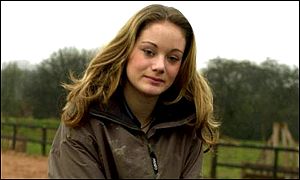
Teenagers and Cosmetic SurgeryBy Catherine RedfernCast your mind back to the start of 2001. The news was full of debates around cosmetic surgery, particularly breast enlargements. It was all sparked off by 15 year old Jenna Franklin, who was thrust into the spotlight when she decided to have breast implants for her 16th birthday. Her mother, who herself had had two breast operations, and who runs her own plastic surgery business, said she and her husband would happily pay the £3,250 for the operation. Jenna was articulate, slim, and pretty, but explained her decision saying she was unhappy with her body and that a breast enlargement would give her more self-confidence and get rid of her hang-ups. She also asserted that you need big breasts to be successful in life, naming various celebrities such as Britney Spears and Pamela Anderson as proof. There was a flurry of press comment and criticism. She's far too young, they said (i.e. if she was a bit older there'd be no problem); she probably hasn't finished growing, they said (i.e. if she waits a while, she might get bigger breasts, then she'll be okay); she's emotionally too young to cope with the repercussions, they said. No-one seemed to question the fundamental assumptions behind it: that 'big' breasts are desirable; why breasts are such an issue; that if a woman thinks she has small breasts she should want to change them. Soon after, Channel 4 showed a documentary called 'Perfect Breasts', investigating the apparently growing phenomenon of young women opting for cosmetic enhancement. The programme featured women and girls explaining how they were unhappy with their bodies, and how they 'just want to look normal.' Interesting. The bit I remember most is a scene of two sisters, both who'd had breast implants, eating dinner with their parents and discussing the possibility that they may never be able to breast feed a baby. The younger sister said it didn't bother her in the slightest, that the very idea of her breasts being used to nourish a baby was repulsive. "They're sex objects, to me" she explained with gusto, giggling, "Sex objects!" Her father mumbled nervously in protest. "Most natural thing you can do, breast feeding..." but he was soon drowned out by the chatter from the women. It struck me as humorous, strangely sad, and also telling about different attitudes to the humble breast. Now, teenagers having cosmetic surgery is not new. It's been happening in the USA for years. In the richer American cultures for their 16th birthday, boys get a car, girls get a nose-job. Even over here the issue is old news. In 1998 the BBC investigated younger and younger girls having cosmetic surgery, and plastic surgeons willing to offer it to them. In 1999 they reported what women wanted; Emma Bunton's nose, Melinda Messenger's breasts, thighs of Naomi Campbell, etc. Recently WH Smith began stocking 'Cosmetic Surgery Magazine'. It's not the specific issue of breast implants I am talking about really. Neither is it the young age of these girls: I've argued in another article that 16 years olds should be treated as young women and their opinions respected (only if they agree with me, of course! ;-)). The solution is not to ban 16 year olds from having plastic surgery, or ban it altogether. I'm all for the fundamental right of women to do what they want with their bodies and make their own decisions about their lives. BUT I believe there is a more fundamental issue here; that what's behind this are some unquestioned assumptions about womens bodies that our society subscribes to. These assumptions are: 1. Something is fundamentally wrong with the female body and it's natural to be unhappy with it. It's not just natural teenage insecurity either. In our society, adult female bodies are treated like mistakes that continually need correcting. It's too smelly, it's too hairy, it's the wrong shape, it's the wrong colour. We're seen to be badly designed somehow, needing extra stuff to make them okay. Being unhappy about your body is often presented as one of the essential personality traits of women, if we believe what society tells us. I've heard many times suggested, often humorously, that in the darkest ages of humankind, women were whining to their caveman mates, 'does my bum look big in this loincloth?' Silly yes, but there's also a subtext that says it's something women have always done and will always do. We just instinctively hate our bodies, and, we are brought up to believe, with good reason. Take Bridget Jones and her ilk. Women who are obsessed with how they look, the size of their bum, and convinced they are the wrong shape are an absolute staple of women's fiction, and Bridget is hailed as representing 'everywoman'. Of course Bridget is humorous, and exagerrates the obsessiveness to comic effect; but the fact is there is something in all exagerrations that we are supposed to understand and relate to. They simultaneously take the piss out of such irrational concerns and enable us to sympathise with them, whilst stuffing us with the unsubtle morality: maybe you're not as fat as you think you are and maybe just maybe, looks don't matter that much. Well gee, thanks for pointing that one out! How many times have you had to convince your friends that their bum is not as big as they think it is? I've heard this from the skinniest friends of mine, obsessing about parts of their bodies. It's come to something when the best way to comfort and reassure them is to act like you're jealous; 'Your bum's nonexistent, you bitch!' The TV fashion and beauty programme 'She's Gotta Have It', trailed their new series mentioning 'the hang ups we all have'. The hang ups we all have. Proves my point perfectly. It's almost seen as an essential part of the female experience. If I was to say, if asked, that I'm completely happy with my body and wouldn't want to change it, I'd be viewed as an arrogant cow. Who does she think she is? What's the question female celebrities are usually asked in interviews? 'If you could change any part of your body, what would it be?' Surely we can come closer to a feminist critique of the beauty myth than letting celebrities and models admit that, guess what? They hate their bodies too. 2. If we're unhappy about our bodies, we should change it. And, women are changeable creatures. If you think there's something wrong with your body, change it. If your lips arn't the right shape, fake it. If your hair is the wrong colour, dye it. If your skin isn't matte enough or glossy enough or good enough, change it. If your eyelashes are too thin, change it. If your body isn't good enough, get something done. Girls who've been brought up on the idea that our bodies can be altered at a whim by make-up and everything else, think of cosmetic surgery as the next logical step. People who attack cosmetic surgery but don't see the connection with other forms of women changing and camoflaging our bodies to fit the social norms are missing something deeper. I'm not saying that if you wear lipstick you will eventually have a boob job. Of course not. But I think it's on the same spectrum; something you do to change yourself and make yourself acceptable. If you put on makeup every day to face the world, to correct and improve your face, you are falling for the same lie; the underlying idea that there is something unacceptable about you that needs to be corrected. I'm aware I sound really radical here! I'm torn every day between my feminist ideals and the impulse to just - well, lighten up. I don't know where the dividing line is between adorning and decorating our bodies to add colour and fun to the world, and changing our bodies to present a false image to be acceptable. Where does one end and the other begin? It's a tricky one. On the one hand I refute the concept that there is an unchangable standard of beauty and it's only natural and right that women should try to attain it. But on the other, I'm not suggesting there is anything wrong with having a fashionable hair cut, being interested in trendy clothes, or being bright and colourful. And I can't deny the fact that makeovers are just - well - fun! Nevertheless, I think that women are seen, far more than men, as changable creatures. As Richard Madely from 'This Morning' said, before a foreign young woman who'd never worn make-up before underwent a makeover; 'She's a real blank canvas'. As the Head and Shoulders ad with the Mona Lisa wannabe puts it; 'a work of art'. She literally is a blank canvas; painted by a man. Nothing demonstrates more clearly that women are seen as changeable creatures than the makeover. The traditional before and after shots; the gasps when the 'new' woman is brought out 'you look amamzing!'; the fact of how completely different they look surely says something about how femininity is a construction. Ever noticed that men who have makeovers don't look as different as the women tend to do? Does this mean that women are essentially, inherently, blank canvases to be filled in and altered by fashion stylists, make-up artists - or plastic surgeons? I'd like to think not. There are many, many examples of the makeover factor, and of women being encouraged to change themselves to fit in with what other people think they should be. At the end of the film The Breakfast Club, the coolest female character who dresses in black, sulks and peers out from under her duffle coat through thick black eyeliner, gets madeover and is instantly more attractive and acceptable to the other characters. She's forced into white, prissy clothes - an alice-band, for goodness sake - and gets to wear make-up, which instantly makes her look far better, of course, and allows her to get the guy. In Grease, Sandy only gets to be popular when she rejects her uncool look and fakes it as a raunchy leather-clad wild-child. As an uncool girl myself at school, it seemed like a surrender. Similarly, I remember watching Neighbours years ago, when plain Jane gets made-over for a prom and emerges sparkling into the living room and shocks her date, who had previously been grumpily expecting to have to go to the prom with the ugly girl. How many times have we seen that tired plot line? Many times, in stories like Cinderella and My Fair Lady, updated for modern times by Miss Congeniality, in which Sandra Bullock plays an 'unladylike' FBI agent who gets to work undercover as a beauty queen. The trailers showed a male collegue shouting at her 'Don't worry - no-one thinks of ya that way.' Presumably, when she emerges swaying in a tight pink dress, hair gleaming, they darn well do. So, breast surgery is just a type of makeover for girls who want to 'look normal'. Nevertheless, some women have claimed that getting a boob job is a feminist act. All the women who get breast enlargements will claim they are doing for themselves, not for anyone else; they're doing it to empower themselves. Of course they are doing it for themselves. Who else would they be doing it for? But the fact is, they're doing it so they'll be happy with their own body, in a breast obsessed society. I find it hard to believe that if they lived in a remote society and had never heard of cosmetic surgery, they'd somehow have an inherent, deep-seated unhappiness with the size of their breasts and want to make them bigger. So, I think this is what's behind the breast implant boom. The underlying expectation that women hate their bodies, which becomes a self-fulfilling prophecy. And the idea that women are changeable, able to make ourselves over in a few hours, or by a team of make-up artists and hair-stylists, or indeed, by a few days spent having plastic surgery. Added to a culture obsessed with a part of the female body - the breast at the moment, there you have it. It's heartbreaking to see young women convinced there's something repulsive about their own bodies. But you can't condemn women for having breast implants if you think its normal to refuse to leave the house without make-up. It springs from the same root. For further reading, I really recommend the excellent book The Beauty Myth by Naomi Wolf.
The Beauty MythBy Catherine RedfernAre we exploited by the cosmetics industry? "Wearing makeup is an apology for our actual faces" - Cynthia Heimel "Every woman knows that, regardless of all her other achievements, she is a failure if she is not beautiful... The UK beauty industry takes £8.9 billion a year out of women's pockets. Magazines financed by the beauty industry teach little girls that they need make-up and train them to use it, so establishing their lifelong reliance on beauty products." - Germaine Greer, The Whole Woman "Because I'm worth it." - L'Oreal slogan "You will soon be able to take a pill and, in 20 to 25 minutes, a non-synthetic substance will colour your lips. Five years from now, you will be able to put a drop in your eyes to change their colour." - Dominique Moncourtois, International Creative Director, Chanel "We are in the midst of a violent backlash against feminism that uses images of female beauty as a political weapon against women's advancement: the beauty myth... As women released themselves from the feminine mystique of domesticity, the beauty myth took over its lost ground, expanding as it wanted to carry on its work of social control... The beauty myth tell a story: the quality called 'beauty' objectively and universally exists. Women must want to embody it and men must want to posses women who embody it... None of this is true." - Naomi Wolf, The Beauty Myth "Resolution Number 1: 'I won't leave the house without make-up'" - From a 'resolutions' article in Superdrug's 'Spirit' magazine Februaury 2001 "We're all brought up on fabulously glamorous Vogue models, and we don't realise that they don't look like that in real life. It is just that the photographers are terribly clever. Women are constantly presented with a false image of beauty that nobody can attain, not even the most beautiful, unless you've got an entourage of make-up, wardrobe and hair backing you up... I really resent the pressure put on women to alter ourselves... Either people like me or they don't. And if they don't becuase of how I look, then they're shallow twats." - Amanda Donohoe, Independent on Sunday, 4 March 2001 "It's what makes you a woman." - Paloma Picasso, Fashion Designer "Lipstick is something that makes you feel good about yourself." - Naomi Campbell, Model "It's a source of female power." - Barbara Daly, Make-Up Artist "All in answer to the question 'Why do women wear lipstick?'," in NOVA June 2000. "As women strive to break free of constricting stereotypes of who they are and what they want, idealized feminine beauty must be identified as part of that challenge. It is not merely a decrorative diversion. The sense of self resides within the body." - Rita Freedman, Beauty Bound "Maybe she's born with it. Maybe it's Maybelline." - Maybelline slogan "The average woman eats between four and ten pounds of lipstick in her lifetime." - From postcard by Stella Marrs "Unlike our feminist foremothers, who claimed that makeup was the opiate of the misses, we're positively prochoice when it comes to matters of feminine display. We're well aware, thank you very much, of the beauty myth that's working to keep women obscene and not heard, but we just don't think that transvestites should have all the fun. In our fuck-me dresses and don't-fuck-with-me shoes, we're ready to come out of the closet as the absolutely fabulous females we know we are. We love our lipstick, have a passion for polish, and basically, adore this armor we that we call 'fashion.' To us, it's fun, it's feminine, and, in the particular way we flaunt it, it's definately feminist." - Debbie Stoller, The BUST Guide to the New Girl Order "Empowering. Illuminate your own beauty from within, through the power of Advanced Luminous Technology." - Shiseido makeup advert
Other Topics Concerning Fashion & Feminism:
| ||